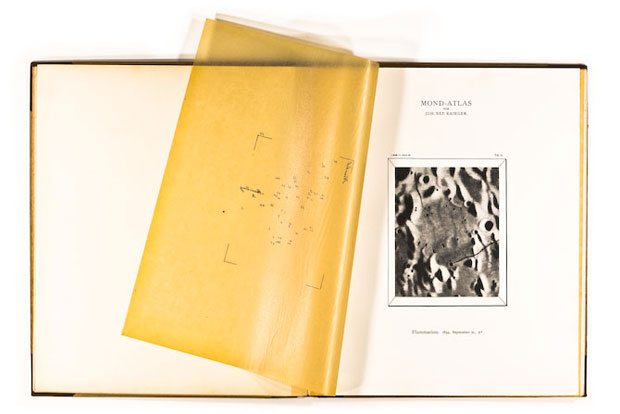
Photography in the service of drawing
Lick's fine series of moon pictures represented some of
the best lunar photography of its time, but thanks to the eye's ability to pick out fine features in
brief moments of atmospheric clarity, visual lunar observers with good telescopes at good sites could
still detect more detail than a photograph. Further, even the very best photographs suffered
substantial loss of detail when reproduced for publication.
An interesting hybrid of photography and visual observing, drawing on the
best properties of each, appears in the work of the German observer Johann Nepomuk Krieger, who
used low-contrast prints of Lick plates as a base for drawings made at his telescope.
The prints provided accurate positional
information, freeing Krieger to concentrate on filling in fine detail visible to the eye.
Krieger's beautiful 1898 Mond-Atlas is shown above. Sadly, his plan to completely map the moon
was cut short by his death at thirty-seven, quite possibly the result of exhaustion brought on by long
hours of observing.
The Hungarian selenographer Ladislaus Weinek also made use of Lick plates,
making faint prints on special paper, which he then painstakingly highlighted in
watercolor to bring out detail. The 1897 first fascicle of his (never completed) lunar atlas was the
first based on photography.
Private collection.
|