Astronomy before telescopes
 Ancient astronomers plotted the courses of the stars and planets for navigation, calendar
making, and astrology.
They observed with naked-eye instruments that enabled them to mark positions and
measure angles in the sky. They could predict the positions of the planets with fair accuracy, and
even forecast eclipses. Most of those who long ago toiled under the stars are now forgotten, but parts of their
legacy have survived.
Claudius Ptolemeus, also known as Ptolemy, was active in Roman-ruled Egypt
in the second century A.C.E., and is perhaps the best remembered astronomer of antiquity. His
renown rests in large part on his Almagest, a star atlas and set of
planetary tables based on the work of earlier observers. The Almagest remained the most
influential astronomical text nearly up to the time of the invention of the telescope, 1500 years
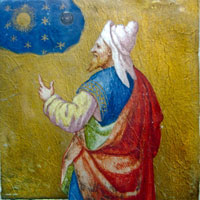
after its publication. Ptolemy, above left, is pictured in a sixteenth century manuscript illumination
surveying the heavens.
The high-water mark of visual observing came at the end of the sixteenth century with Danish
astronomer Tycho Brahe. The size and precision of the instruments he constructed at his island
observatory, Uraniborg, enabled him to produce observations an order of magnitude more accurate
than anything that had come before. His precise measurements
of Mars provided Johannes Kepler the data from which he derived his laws of planetary motion, one of the most
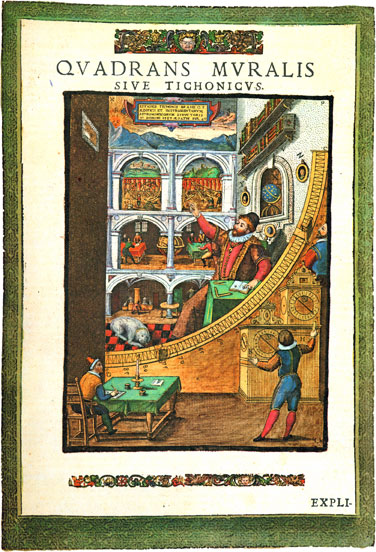
important contributions to astronomy of all time. Tycho, above right, is shown, larger than life, seated with
his great mural quadrant—an instrument for measuring the elevations of stars—in a
famous woodcut from Astronomiae instauratae mechanica, his magnificent book
describing his observatory.
Ptolemy surveying the heavens: manuscript illumination, Italy, 16th c., private collection.
Ancient astronomers plotted the courses of the stars and planets for navigation, calendar
making, and astrology.
They observed with naked-eye instruments that enabled them to mark positions and
measure angles in the sky. They could predict the positions of the planets with fair accuracy, and
even forecast eclipses. Most of those who long ago toiled under the stars are now forgotten, but parts of their
legacy have survived.
Claudius Ptolemeus, also known as Ptolemy, was active in Roman-ruled Egypt
in the second century A.C.E., and is perhaps the best remembered astronomer of antiquity. His
renown rests in large part on his Almagest, a star atlas and set of
planetary tables based on the work of earlier observers. The Almagest remained the most
influential astronomical text nearly up to the time of the invention of the telescope, 1500 years
after its publication. Ptolemy, above left, is pictured in a sixteenth century manuscript illumination
surveying the heavens.
The high-water mark of visual observing came at the end of the sixteenth century with Danish
astronomer Tycho Brahe. The size and precision of the instruments he constructed at his island
observatory, Uraniborg, enabled him to produce observations an order of magnitude more accurate
than anything that had come before. His precise measurements
of Mars provided Johannes Kepler the data from which he derived his laws of planetary motion, one of the most
important contributions to astronomy of all time. Tycho, above right, is shown, larger than life, seated with
his great mural quadrant—an instrument for measuring the elevations of stars—in a
famous woodcut from Astronomiae instauratae mechanica, his magnificent book
describing his observatory.
Ptolemy surveying the heavens: manuscript illumination, Italy, 16th c., private collection.Tycho Brahe's mural quadrant: from Astronomiae instauratae mechanica, 1598, source:Wikimedia Commons.